Loading...
Serving Charlottesville, VA and surrounding areas. (434) 235-6128
Your old driveway is cracking, settling, or draining toward the house. We build new concrete driveways with the base prep and mix design that Charlottesville winters actually require.
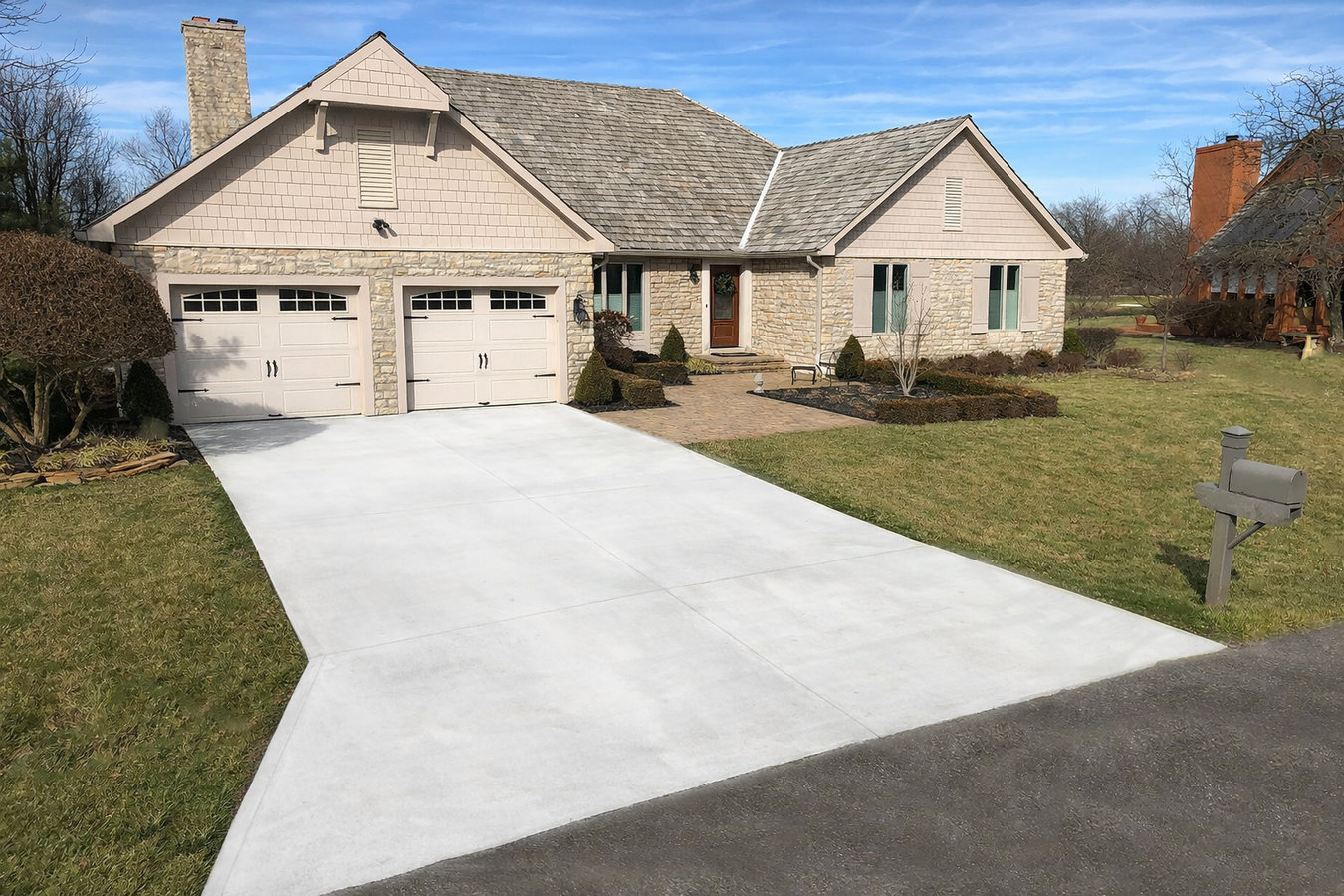
A new concrete driveway in Charlottesville involves demolition of the old surface, compacted gravel base installation, formed concrete pour with control joints, and a curing period before use - most residential projects take two to three days of active work plus one week of hands-off curing time.
If you own a home in Charlottesville, your driveway faces real stress every winter. Freeze-thaw cycles crack surfaces that were not mixed or sealed for Virginia conditions. The clay-heavy Piedmont soil shifts with seasonal moisture, and a driveway poured on a poorly prepared base will show it within a few years. Getting this right starts underground, not at the surface.
A new driveway solves more than curb appeal. It fixes drainage, eliminates tripping hazards from settled slabs, and protects your foundation from water that has been running the wrong direction for years. If you are also thinking about your outdoor surfaces, see our concrete patio construction work.
A crack or two is normal, but when you see a spreading network of cracks - sometimes called map cracking - the slab has likely reached the end of its life. In Charlottesville, this pattern develops faster than homeowners expect because freeze-thaw cycles widen small cracks every winter. Patching is only a short-term fix at that point.
If chunks of the surface layer are breaking off or the concrete looks rough and pitted where it used to be smooth, moisture and freeze-thaw damage have reached the surface. This is especially common on older Charlottesville driveways that were never sealed or were exposed to road salt tracked in from winter driving. It tends to get worse quickly once it starts.
When parts of your driveway sit at different heights - one slab dropped, another pushed up - the ground underneath has shifted. In Charlottesville, this is often caused by clay-heavy soil expanding and contracting with seasonal moisture. Uneven sections are a tripping hazard and a sign the base is no longer stable.
Standing water near the house after rain means your driveway is no longer draining correctly. This can happen when a driveway settles unevenly or was never graded properly. In Charlottesville's hilly neighborhoods, poor driveway drainage can quietly push water toward your foundation for years - a problem far more expensive than a new driveway.
We handle the full scope of residential driveway work in Charlottesville - from single-car aprons to two-car pads with decorative finishes. Every project starts with demolition of the existing surface if needed, full sub-base preparation using compacted gravel, and formed pours with proper control joints. We also handle concrete parking lot building for homeowners with additional vehicles, detached garages, or larger pads.
Finish options include standard broom-finished gray, exposed aggregate for texture and grip, stamped patterns to match stone or brick, and colored concrete for curb appeal. Plain gray is the most budget-friendly. Decorative finishes add cost but change how the entire front of your home looks. We will show you samples and photos before you commit, because the finish is permanent.
Best for homeowners who want a clean, durable surface at the most straightforward price point.
Suited for homeowners who want the look of stone or brick with the strength and cost advantage of concrete.
For properties where demolition of the existing surface is needed before a fresh pour can begin.
For homeowners who only need the section connecting the street curb to the main driveway replaced or rebuilt.
Charlottesville sits in the foothills of the Blue Ridge Mountains, and the combination of clay-heavy Piedmont soil and genuine cold winters creates conditions that are harder on concrete driveways than most homeowners realize. The red clay soil that runs through most residential lots in the area swells when wet and shrinks when dry - and that movement puts pressure on any slab sitting on top of it. A concrete driveway contractor who does not account for this with a proper gravel base is setting you up for cracking and settlement within a few years. Homeowners in Charlottesville and nearby Waynesboro see the same soil and weather patterns - and the same failure modes when driveways are not built for them.
The city also requires a permit for new driveway construction, and many established neighborhoods have HOA guidelines covering driveway materials and width. We handle the permit process with the city so you do not have to manage paperwork or make calls to the development office. The city permit process includes an inspection, which is documentation that your driveway was built to code - something that protects you when you sell your home. For more on local permit requirements, the City of Charlottesville Neighborhood Development Services office is the direct source.
We come to your property, measure the area, and look at the slope and soil. You get a written quote covering demolition, base prep, pour, finishing, and cleanup - no surprises on the final invoice. We reply within one business day.
We pull the required city permit on your behalf. Permit processing typically adds a few business days to a couple of weeks to the timeline. Once it is approved, you get a confirmed start date.
The first day covers removal of the old surface, grading, compaction, and gravel base installation. This step is what separates a driveway that lasts 30 years from one that starts cracking in five.
Day two is the pour and finishing. The driveway will look complete, but needs at least a week of curing before passenger cars can use it. We walk the finished surface with you before we leave the job site.
Get a written estimate with no obligation. We handle the permit, the base prep, and the pour - you get a driveway built for Virginia winters.
(434) 235-6128Charlottesville's Piedmont clay shifts every season. Every driveway we build starts with excavation deep enough to get below the problem soil and a compacted gravel base that gives the slab a stable foundation. This is the step that determines whether your driveway lasts five years or thirty.
On Charlottesville's sloped lots, a poorly graded driveway quietly pushes water toward your foundation. We walk every site before we pour, and every driveway is sloped so water flows away from the house. You will not be dealing with a wet basement because of us.
Your quote covers demolition, base preparation, the pour, finishing, and cleanup before anyone picks up a shovel. If something changes during the project, you hear about it before it happens. The American Concrete Institute's{' '} published guidance on concrete construction supports transparent upfront project documentation. See{' '} their resources at{' '} concrete.org.
The City of Charlottesville requires a permit for new driveways. We pull it on your behalf, schedule the required inspection, and give you documentation that the work was done to code. That record matters when you go to sell your home.
Every one of these details connects to something that affects how long your driveway lasts and how much you spend maintaining it over the next decade. We handle all of it so you do not have to keep track.
More questions? The Portland Cement Association and the American Concrete Institute publish detailed homeowner guides on concrete construction and maintenance.
Add a defined outdoor living surface to your backyard with a concrete patio poured for Charlottesville's climate.
Learn MoreLarger paved areas for additional vehicles, detached garages, or commercial-use surfaces built with the same base prep standards.
Learn MoreSpring is the best time to schedule - permits move faster and curing conditions are ideal. Call or send a message and we will get back to you within one business day.