Loading...
Serving Charlottesville, VA and surrounding areas. (434) 235-6128
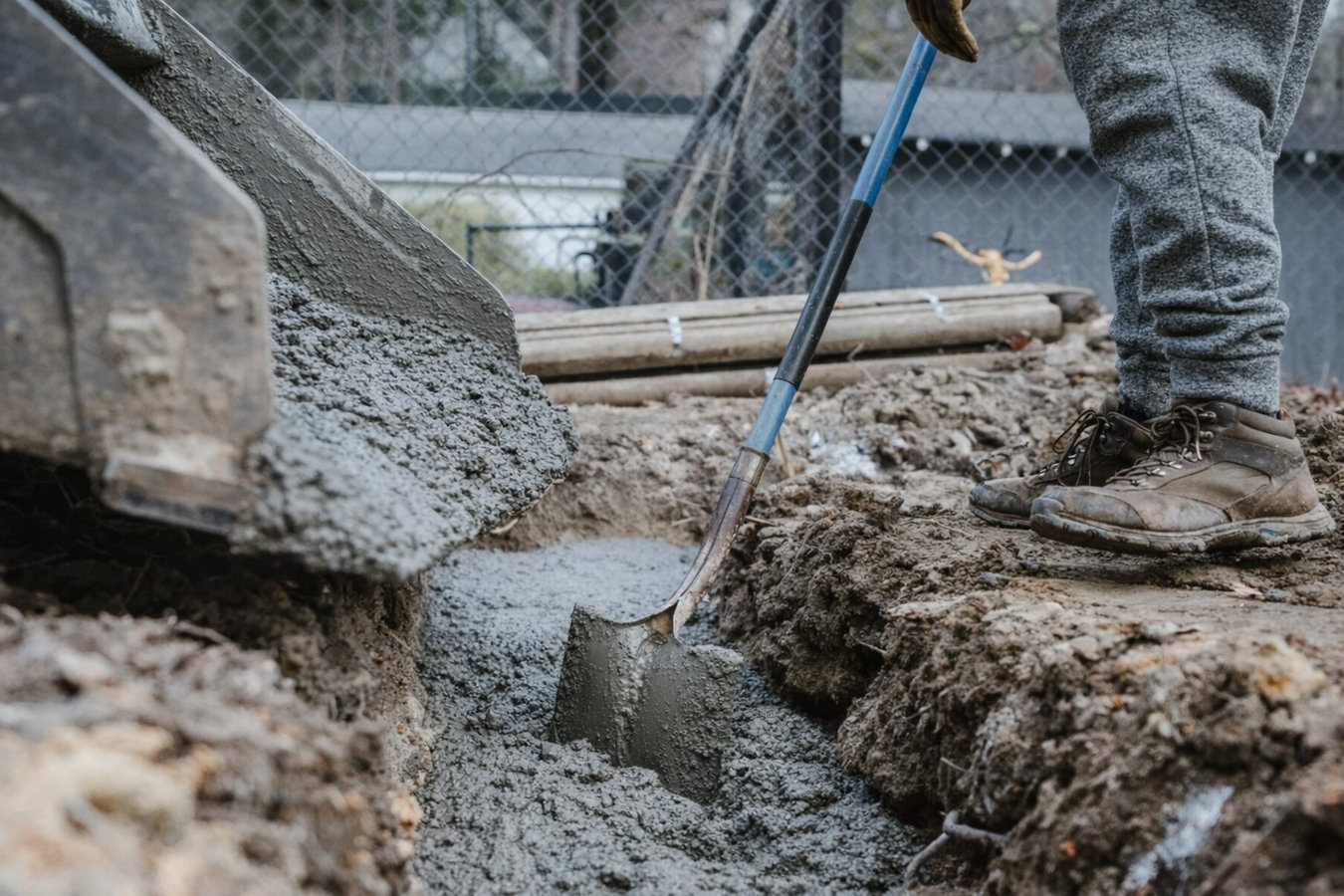
A deck, addition, or outbuilding is only as solid as what it sits on. We install concrete footings sized for Charlottesville's frost line and clay soil - with permits, inspections, and no shortcuts underground.
Concrete footings in Charlottesville are buried pads of reinforced concrete that carry the weight of a deck, addition, or outbuilding and spread it safely into the soil below - the crew digs down to at least 18 to 24 inches below the surface to reach below the frost line, sets forms, places rebar, pours the concrete, and the active work typically takes one to three days before the permit inspection clears the pour.
Most Charlottesville homeowners need footings when they are building a deck, adding a sunroom, putting up a detached garage, or adding a large shed. The job looks simple from the outside - it is mostly underground - but the depth, width, and reinforcement of the footing all matter enormously. A footing that is too shallow will get pushed around by the ground every time it freezes and thaws, and Charlottesville winters provide plenty of opportunities for that to happen. Homeowners planning a full addition often look at this work alongside foundation installation to understand how the two types of work fit together.
Footing work in both the City of Charlottesville and Albemarle County requires a permit and an inspection before the concrete is poured. A contractor who handles that process without being asked is doing things the right way.
If you notice diagonal cracks running from the corners of door frames or windows, or long horizontal cracks in a basement wall, the structure above may be moving because the footing below is shifting. In Charlottesville's clay-heavy soil, this kind of movement is more common than homeowners expect - especially after a very wet spring or a dry summer. These cracks do not always mean disaster, but they do mean a professional should take a look before you plan any new construction nearby.
When a footing settles unevenly, the frame of the house above it can rack slightly out of square. You may notice a door that used to close easily now drags on the floor, or a window that no longer latches. This is one of the earliest signs that something is shifting underground, and it is worth investigating before you plan an addition or deck that would rely on the same area of the foundation.
Any new structure attached to your home or built on your property - a deck, a sunroom, a detached garage, a large shed - needs its own properly sized footings before construction begins. In Charlottesville, this work requires a permit, and the inspector will check the footings before the concrete is poured. Starting this conversation with a concrete contractor early in your planning process saves time and prevents costly redesigns later.
If you can see a gap between your deck ledger board and your house, or between a porch column and its base, the footing below may have shifted. Charlottesville's freeze-thaw winters are a common cause - footings that were not buried deep enough get pushed up by frozen ground and never fully settle back into place. A contractor can assess whether the footing needs replacement or whether the structure above can be re-secured.
We install concrete footings for decks, additions, garages, outbuildings, and fence posts throughout the Charlottesville area. Every project starts with a site visit so we can look at the soil conditions, assess the slope, check proximity to utilities, and determine the correct footing depth and width before quoting. From there we handle the permit application, excavate to the right depth, set forms, place rebar, pour the concrete, and coordinate the city or county inspection before the pour - so your project record stays clean and your structure is built on a footing that was actually checked by an inspector before it was buried.
We also assess existing footings on older homes before any new work is designed. Many properties in Charlottesville's established neighborhoods were built before modern footing requirements existed, and adding onto a home without understanding what is already underneath can create problems once digging starts. Homeowners who are adding a larger structure often combine footing work with foundation raising if the existing foundation has settled unevenly, which allows both issues to be resolved in the same project.
For homeowners adding an attached or freestanding deck - sized and buried to handle Virginia frost depth and meet permit requirements.
For sunrooms, bump-outs, or room additions that connect to an existing home - designed to match the existing foundation system.
For new detached garages or carports - sized for the structure's load and coordinated with slab or floor installation.
For larger sheds, workshops, or accessory structures that need a proper footing rather than piers or blocks.
For older homes where prior footing work is unknown - a site evaluation before any new construction begins on or near an existing structure.
For situations where a footing has shifted, cracked, or settled unevenly - assessed and replaced to restore structural stability.
Charlottesville sits at the eastern edge of the Blue Ridge Mountains, where winter temperatures regularly dip below freezing and then climb back above it within the same week. That repeated freeze-thaw cycle is hard on anything in the ground, including footings that were not placed deep enough. For a homeowner in Belmont or the neighborhoods around the University of Virginia, this matters in a specific way: many homes in those areas were built in the early to mid-1900s, when footing standards were far less rigorous than they are today. Adding onto one of those homes without first assessing what is already underground is how projects go sideways. The red clay soil common throughout the Piedmont adds another layer - it swells when wet and shrinks when dry, which puts extra stress on footings that were not sized with that movement in mind. The International Association of Certified Home Inspectors publishes guidance on what proper footing work looks like - and what the warning signs of poor work are before it is buried.
Permit requirements also vary depending on whether your property falls within the city limits or in Albemarle County. Both jurisdictions require an inspection before the concrete is poured, but the permit offices are separate. Homeowners in Charlottesville and in surrounding communities like Staunton benefit from working with a contractor who already knows which office handles their address and how to file with the right one without delay.
When you reach out, we will ask about what you are building, where on your property it will go, and whether you have already spoken with a designer or builder. We typically respond within one business day. This conversation helps us decide whether we need a site visit before giving you a price - for most footing projects, we do.
We visit your property to look at the soil type, slope, equipment access, and proximity to utilities or existing structures. You will receive a written estimate that specifies the depth and width of the footings, total footage, excavation, materials, and labor. Ask any questions about the permit process at this meeting.
Before any digging begins, we apply for the building permit through the City of Charlottesville or Albemarle County - whichever applies to your address. This step typically takes a few business days to a couple of weeks depending on the time of year. We handle the paperwork and coordinate the required inspection.
On the day work begins, we dig to the required depth, set forms, and place rebar. The city or county inspector visits before any concrete is poured - this inspection confirms the work matches the approved plans. Once the inspector signs off, we pour, smooth the top, and leave the footing to cure. Wait at least one week before placing any significant load on the footings.
We visit your property first and send a written estimate that specifies depth, width, and what is included. No guesswork, no surprises.
(434) 235-6128Footings in Charlottesville need to reach at least 18 to 24 inches below the surface to stay below the frost line - shallower than that and the freeze-thaw cycle will eventually push them. We also account for the red Piedmont clay that underlies most local yards, adjusting footing width based on actual soil conditions rather than a standard template. The Portland Cement Association outlines the curing and strength standards we follow on every pour.
The City of Charlottesville and Albemarle County are two separate permit offices with different applications and timelines. We know which one applies to your address and file with the right one. We also coordinate the pre-pour inspection - so your footing is checked by an inspector before it is buried, which keeps your home's records clean for any future sale or refinance.
Homes in Belmont, Fry's Spring, and the neighborhoods near the University of Virginia were often built before modern footing requirements existed. If you are adding onto an older home, we assess what is already there before we design anything new - so you are not surprised by what we find once the digging starts. That honesty upfront saves time, money, and headaches.
A footing bid that does not specify the depth and width of the footings is not a real bid. Our written estimates spell out exactly what we are digging, how deep, how wide, how much rebar, and what concrete thickness is included. You can compare that directly against any other quote you receive - and the differences you find will tell you a lot about who is cutting corners on the design.
Every one of these points comes back to the same goal: a footing that does its job for the life of whatever is built on top of it - staying level through decades of Virginia winters and Piedmont clay movement without anyone ever having to think about it again.
If an existing foundation or footing has already settled unevenly, foundation raising corrects the problem before new construction begins on or near it.
Learn MoreFor new homes and full additions that require a complete foundation system - crawl space, slab, or full basement - rather than individual footings.
Learn MoreSpring permit queues fill fast - reach out now and lock in your start date before the season gets busy.